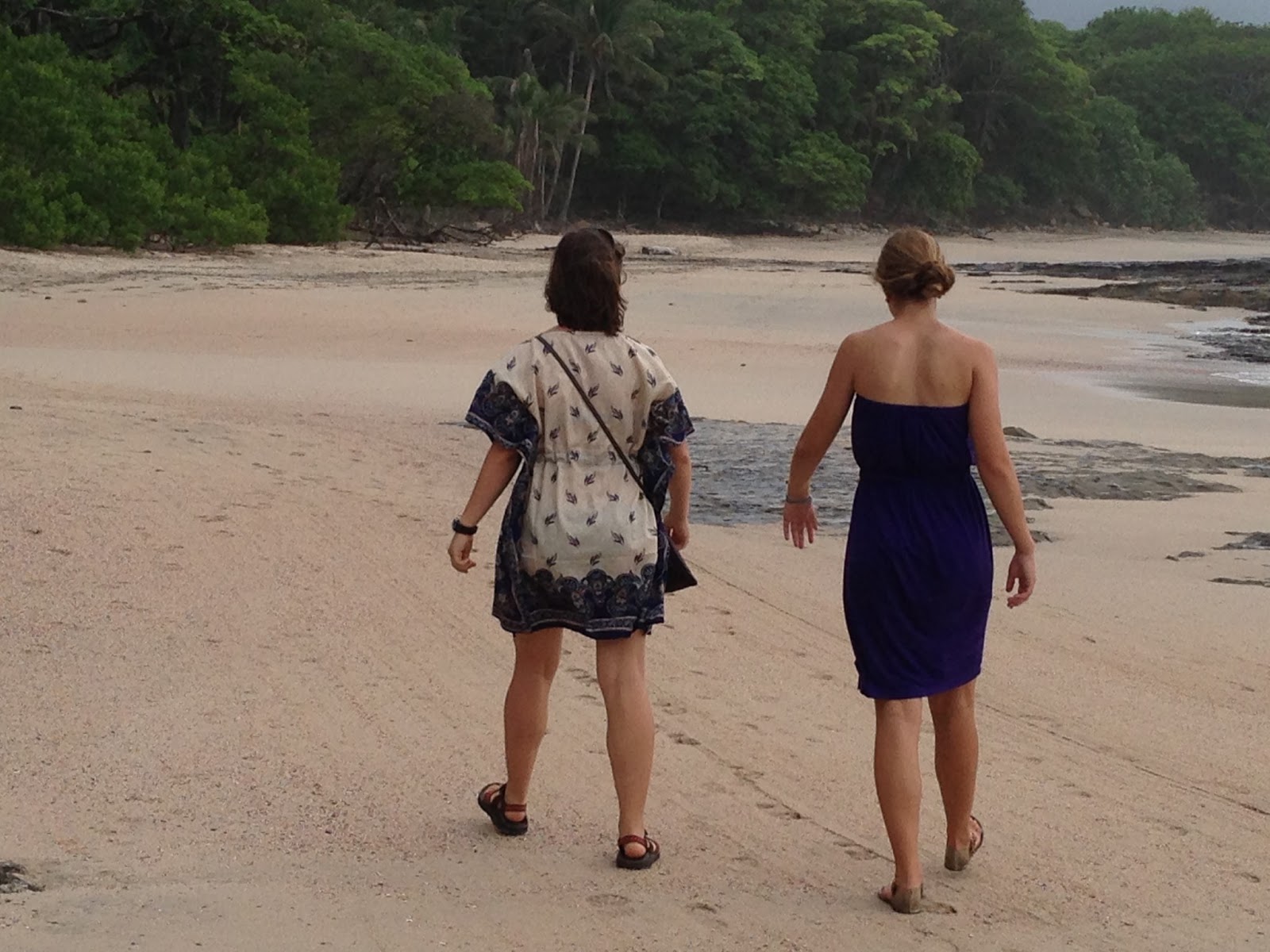
“You should
totally come check out the Topanonna tonight,” Morgan encouraged in a lilting South
African accent. It was hard to tell whether her bleached hair and bronze skin
were artificial or truly sun kissed, but as she finished off her Angkor beer, her
mildly plump body candidly testified to the accommodation of a few extra drinks.
“Yeh, it’s the chillest place in town,”
Hayley, her Kiwi companion, agreed. Tints of red glimmered in her otherwise
brunette hair, which was carelessly pulled into a loose bun on the top of her
head. “Ev’rybody is so, so friendly.
Loads of backpackers are coming in and out all the time, so you’re always
meeting people. I’m so glad I found it.”
My three week stint in Cambodia
included twelve other companions, a tour bus, and a thorough itinerary, so this
spontaneous invitation offered at a cheap restaurant along Phnom Penh’s riverfront
was an unexpected start to my travels. It was only my second day here, and I
was already beginning to resent the organized structure of the trip. I fiddled
with the coconut leaf bowl in front of me, unable to eat another chalky bite of
my first Cambodian cuisine specialty, Amok Trei, a fish coconut curry soup
served with the typical perfectly round scoop of steamed rice. Despite street
kids hassling me to buy scarves and postcards for the past fifteen minutes, I
remained under the two second periodic breeze of the restaurant’s oscillating
fan, unwilling to face the sticky humidity outside. This heat was my punishment
for coming to Cambodia in May, the dry season for rice patties and tourists
alike. When Morgan and Hayley entered the restaurant, the kids abandoned me,
hoping to find more eager customers in the new arrivals. As they continued to
try to sell their paraphernalia, Morgan patiently answered their stream of questions.
“Buy some bracelets from me?”
“No thank you, we don’t need any.”
“You can take back to your mom or
sisters!” another persistent girl pushed. With creased eyebrows and a jutting
lower lip, a whiny pout replaced the angelic face I had seen mere moments ago.
“We’re not tourists. We teach school
here.”
“How old are you?”
“Twenty.”
I couldn’t help but eavesdrop.
Curiosity, followed closely by envy, got the better of me. They were my age,
and they had begun their lives. While I plodded along pursuing my undergrad
degree, teaching English abroad someday only a blurry future possibility,
Morgan and Hayley were doing it. They were independent, living in a foreign
place with real jobs. I must talk to
these girls.
“Well, that
sounds pretty cool,” I replied. “Where is this place? What is it exactly? I
don’t really know what I’m up to tonight, but maybe…”
My good girl reputation has followed
me into adulthood. Growing up, I was the over achieving perfectionist. I never
drank, never had a boyfriend, and rarely missed class or church. If there is
such a thing as “safe risks,” those are the only ones I took – hiking a dozen
miles, beating the record on high ropes courses, dancing like a fool, and engaging
strangers in conversations. I snuck out once with my best friend just to sneak
out. Learner’s permit in hand, we drove to the sticky twenty-four hour pancake
joint. Such a badass, I know. But I liked it that way. Though I was innocent, I
was also the responsible, mature one, the person everyone came to with their
issues. I had a stream of A’s on twelve
annual report cards, few personal problems, a strong faith community, and
good relationships with my parents, siblings, and friends.
“The Topanonna is the hostel we’re
both staying at. It’s also got a great bar and lounge, and it is the place to hang out,” Hayley
explained.
“Say, why wait ‘til tonight? What are
you up to right now?” Morgan posed. “We
can all grab a tuk tuk and ride over there together.”
***
“Lady, you get pedicure? Very nice. Feet all soft. No more
dead skin.”
I handed the
three crumpled dollar bills over and slid off my clunky Chaco sandals. My feet
were grimy from the dirt they had collected walking through Siem Reap’s Old Market
that day, and the straps left a faint crisscross tan line. Above me, the sign
incorrectly read, “If our fish can’t you happy we will not charge!” I stepped
onto the ladder and crawled, turning along the blue, cushy seat and situating
myself in the middle of the three connected benches. The shimmering tilapia
below me swam about, unaware of their future food. Here goes nothing. I cautiously stuck my sweaty feet about three
inches into the cool water. In a millisecond, the fish swarmed them, and tiny toothless
fish mouths began nipping the bottoms of my feet. Squealing three decibels too
high, I couldn’t control my ticklish kneejerk reaction as I immediately pulled
my feet out of the tank.
My uncouth behavior caused almost
everyone – market customers and shopkeepers alike – in a thirty foot radius to
stare. I tried to regain my composure. Drawing on rudimentary yoga skills, I
sat up straight and slowly exhaled, using my fingers to pull two invisible
strings down to my thighs. Let’s try this
again. I dunked my feet back in, forcing myself to stay still. The lanky
vendor handed a Coca-Cola over to enjoy during this supposedly relaxing live-fish,
dead skin pedicure. I got my thirty minutes’ worth, but I could barely stand
it, nor could I believe I was really partaking in this tourist trap.
But so it
goes in the three Cambodian cities I visit - bustling Phnom Penh, temple-laden
Siem Reap, and tropical Sihounikville. Despite my revulsion to being dependent
on sealed water bottles and Asian English speakers, there are pros to being a
tourist here. My companions and I didn’t have to do any research or
preparations before we arrived. Our highly recommended tour company booked our
hotels, chose the best restaurants in the city, and crafted a detailed
itinerary for our stay in Cambodia. We never got lost; we didn’t even have to
figure out where to go. Our spacious, air conditioned bus transported us
through the unnavigable streets of Phnom Penh and along one and a half lane
potholed country roads. I was only scared for my life a few times.
And thank goodness for Dam, our flat-faced, stocky
guide. If I were to Google “How clueless Americans survive Cambodia,” he would
be the living, breathing version of the top listed results. He knows hundreds
of obscure facts and all the historical dates relevant to this country, patiently
answering our never-ending stream of questions with a “Well actually,” at the
beginning of his response and a deep, yet strangely light-hearted giggle at the
end.
“Don’t pay more than five dollars in
the market,” he instructs us. “They’re cute, but don’t buy from the little kids
either.” “When we go to the Royal Palace, please cover your knees and
shoulders.” As we amble through the
king’s grounds, he points out the Silver Pagoda.
“Why is it called that, Dam?” I ask.
“Well actually, it has 5,239 silver
tiles on the ground, hahuhuhu.” Dam’s genuine smile is never far behind his
characteristic laugh.
To begin with, being a tourist is fun.
Bargaining between a price of four and five dollars for intricately designed
pashmina scarves in the market is a game. I allow myself to enjoy a mango shake
or a special cocktail simply because the third world restaurant prices are so
shockingly affordable. Six dollar massages? Yes please, I’ll take one of those.
Maybe another one tomorrow too.
But touring gets old, fast. I hate
being herded around in a big group, the conspicuous sunburnt white girl among
smooth mocha skin. At Wat Phnom, a Buddhist
shrine atop a man-made mound, we awkwardly flash our cameras amidst
the chorus of xylophones resonating through the temple. Worshipers burn
suffocating quantities of incense and fervently proffer themselves before the
golden Buddha, praying for luck and blessings. Over and over, I pulled my
camera out of my pack and flashed away... in the temples at Angkor Wat, amidst
the solemnity of the Tuol Sleng prison and the Killing Fields, even at the
appallingly poor villagers of the countryside.
I hate feeling like Dam
is my Mother Duck as I waddle after him, that I am incapable of making my own decisions, that I
don’t have the chance to be alone. I want to mess up and learn from my mistakes.
Let me turn the wrong way with an upside-down map, let me get chased (and not
bitten, please) by a villager’s protective dogs. Let me loose, let me travel. After
a week, going out to eat all the time loses its appeal, even if the prices are
cheap. What do I want? What should I go see today? The Khmer Rouge’s
genocidal bloodbath of the 1970s has left its stains, and when I look for them,
I see the effects everywhere. Mine bomb amputees sit on sidewalks begging for a
dollar or selling photocopied guidebooks. There are so many ragged, unschooled
children roaming the streets that it begins to look normal, acceptable even. Dam
tells me that forty-eight percent of the population lives below the ninety-cents-a-day
poverty line. Maybe in a small way my money really is helping the economy, but
I struggle to reconcile the blatant contrast of my consuming tourism with the
horrendous poverty that still plagues this country.
Just like the ones gnawing on my feet,
tilapia swarmed the pond I grew up swimming in; if you were too still, they would
surprise your backside. My sisters and I used to sit on the floating dock and
soak our feet, joking that it was a free spa treatment; we had heard people in
Asia actually paid to have fish bite
them. Now I was one of those crazy tourists – buying a fish pedicure, blowing
through twenties on scarves and mango shakes, and snapping a fifteenth photo of
another dry field. It is convenient, easy,… and repulsive.
***
Considering Morgan’s invitation, the
whimsical adventurer in me agreed without hesitation, while the safe
rule-follower cautioned her. Can I trust
them? What would happen if I said yes? What would I be missing if I declined? Morgan
slouched in the chair, her double-D cleavage threatening to fall out of her low
rib neck tank top. I shifted my glance to Hayley. Surrounded by a dash of light
freckles, her crystal blue eyes were simultaneously piercing as diamonds and
milky as unstirred coffee cream. Neither Morgan nor Hayley were wearing shoes,
and they didn’t seem concerned to be standing barefoot on the unswept restaurant
tiles. The two looked like they had been best friends for years. They seemed
enough like me, wearing the same type of flowy five dollar elephant print pants
I bought the day before. I wanted to get to know them, so I suppressed my reservations.
“No plans,”
I shrugged. “Let’s go!”
We piled into a tuk tuk, Cambodia’s
open-air carriage cab pulled by motor bike, and headed for the Topanonna. On
the way, I learned that Morgan and Hayley had only met two nights before at a
party. Hayley opened the Happy Pizza box and pulled out a cheesy slice,
offering some to me. Realizing this really could be ganja-fortified, I
declined.
“We got jipped, Mo. This is not the
real stuff,” Hayley bemoaned.
“How do you know?” I asked.
“Oh believe me, another guy at the
Topanonna got some real Happy Pizza last week. You could taste it. And definitely feel it.” I laughed along.
We pulled up
to a headache-inducing yellow cinderblock building. It displayed a black
outline of the cityscape, and an artsy sliding iron gate resting open against
the wall. Under the black and red striped hood I read the bold, lowercase
letters: top banana. In a moment of embarrassing epiphany, I realized this was
the Topanonna Hayley had raved over. Top
Banana. Ah, that makes a little more sense. We climbed up a very vertical
staircase, switch backed, and scaled perilously steeper stairs verging on
ladder status, to the open air lounge.
I definitely
would not have ended up at a place like the Top Banana on my own. The hostel had
all the necessary amenities – Wi-Fi, a western toilet, a well-stocked bar – but
it was the environment and the people that gave the Top Banana its trendy, hipster
feel. The speakers jammed a playlist of electric guitar music and hard rock,
and behind rows of alcohol bottles, the chalkboard wall decoratively listed the
bar menu specials. After we splayed across the low level couches, I checked out
a group of lean, scruffy-faced guys smoking against the porch rail. One glassy-eyed
woman with matted hair staggered over to the group and fell onto each of them
consecutively until the last man gripped her waist and conceded an occasional
kiss or rear grab. Eventually she stumbled over to her beanbag in the corner, collapsing
into it with her legs spread wide, silently begging for a man to give her some
attention.
***
Doctor’s
mask fastened and wire brush in hand, I strategically selected the back wall of
the latrine, where I could hide, at least temporarily, from the sun’s beating
rays. Cumulus cottonballs hung in the cerulean sky, and the acres of cleared
rice patty fields beyond me provided a rare and welcome breeze. As usual, thick
humidity coated the stifling hot air. An emaciated cow mozied along the clay
road, creating a cloud of red dust in its trail, and the stupas in the Buddhist
cemetery beyond it proudly preserved the ashes of the village’s deceased in a
variety of bright colors and heights. Our tour company deserved some props.
They believe in service learning and the benefits of voluntourism, so after
excursions and comfy hotel beds in Phnom Penh, the pendulum swung 180 degrees
to a countryside homestay and community project. There was no air conditioning
or running water, and sleep did not even provide relief from the unbearable
heat. Lying on the floor mat in my sports bra, I would stare up at the mosquito
net, feeling pebbles of perspiration develop all over my body, wishing my
dreams would take me somewhere more comfortable. After a sleepless night, each
day we ventured to the remote village of Chrey Cheoung
to renovate the outdoor bathroom at the local school.
I
was determined to put every bit of energy I had into sanding the whitewash off
of this wall. Generally I love serving, but in this case I had no specialized
skills to offer, and I did not understand the point of coming half way across
the world to do a worse job sanding a wall than the malnourished twelve-year-old
staring at my pitiful work. I was certain he could do this better and more
efficiently than I. This homestay was part of our itinerary, though, and if
they really wanted me to sand, I was not going to be a sissy about
this. So I put the brush against the wall and started scrubbing with all the
elbow grease I could muster, bending to get extra throttle in my legs, ridiculously
straddling the corner of the building for that perfect angle. Call me intense.
Or absurd. I only took water breaks when Vet, the company’s director for Service
and Education, told me to pause.
Later that evening, I expressed some of my
qualms to him. With a genial white smile and soft-spoken demeanor, he explained
that when visitors like us participate in community service, we interact with
the locals and gain a more authentic understanding of the people, place, and
culture. After the village decides what project is most needed at a community
meeting, Vet uses the money we contribute to the project to buy materials from
village suppliers and hires off-season farmers to work with us. We help
stimulate the area’s economy, and the locals don’t see the work as charity,
because they take ownership of the project. I began to understand that in this
circumstance, it is not necessarily about how good I am at this work. When I
cease trying to use the zoom function on my camera to bridge the divide between
the locals and me and begin mixing concrete and laying bricks alongside them as
I did the following day, the dynamic shifts. Sometimes, it’s not about the work
at all. On the last day, I picked up litter around the school, but I did it
with the children from the village for a half hour, and then we played freeze
tag together. I didn’t feel guilty, and I didn’t feel like a tourist.
***
Incredulous. That’s all I felt as
Hayley and Morgan relayed their stories of winding up in Phnom Penh. Halfway
through her college education and teacher licensure at her home in Christ Church,
New Zealand, Hayley got antsy. She decided to sell her only valuable possession,
an acoustic guitar she used at night gigs, and made her way to Cambodia. Three
weeks before I met her, Hayley arrived in Phnom Penh on her own without any
plans or preparations. “After only forty-eight hours, I was miserable and
lonely. The hostel I was staying in was a total dump, and I wasn’t meeting
anyone. Now that I’m at the Top Banana, lit’rally ev’rything is different.”
She confessed that she only had a
hundred dollars to her name and needs to make her forty dollar paycheck last
through the month. “It’ll all work out,” she shrugged, without any discernible
concern. This cannot be real. What are
you going to do without money?
Three months ago, Morgan renounced her
privileged life in South Africa and moved to Cambodia with her girlfriend. A
few weeks later, she was single, kicked out of the flat they were renting
together, and nearly broke. When she did stumble upon the Top Banana, it felt
right. The day before we met, rather than heading to the airport and returning home
as her round trip ticket instructed, she decided to stay in Phnom Penh. You intentionally missed your plane home?
Seriously? She doesn’t have any regrets, though. Everybody, she emphasizes
for the fifth time, is just so friendly and happy. “I love it here, and I
wasn’t ready to leave. So I didn’t.”
Because I didn’t understand these
two, I wanted to hear their take on issues I had already noticed plaguing Cambodia.
I began with the street children that bothered us earlier at the restaurant.
“Are those kids really trying to earn
money for school?”
“Maybe a select few,” Hayley began. “But nah,
most of them have sold that stuff along the riverfront every day since they
were four years old.”
“What about the classroom? Is it hard
for you to teach not knowing any Khmer?”
“Eh, I have a small chalkboard the
size of a window. There are only three pencils and not much paper. None of the
kids are really learning, and all of the grades are fake, anyway, so none of it
matters,” Morgan revealed. “The government won’t let you fail them either. They
all pass with good marks.”
“What?! Doesn’t that bother you?” I
asked, failing to suppress my shock. “Don’t you think that’s inhibiting their
education in the long run?”
“Maybe so, but that’s just the way it is here.
Absolutely nothing needs to change.”
“What about all of the prostitutes
and child trafficking? The sex industry is a pretty big issue here,” I pressed.
Surely they disagreed with those practices. “Even I see women standing out on street corners, and I’m oblivious to a
lot of things. We shouldn’t try to combat that?”
“Definitely not. We’ve befriended a
lot of prostitutes, and all the ones we’ve met like it. They don’t want to do
anything else.”
My initial incredulity swelled as
they shared their thoughts.
“I’m not saying we need to come in and change
everything about this culture. It’s wonderful, and in the little time I’ve
spent here, the Cambodians are some of the happiest people I have ever
encountered,” I acknowledged. “But you’re telling me that if your prostitute
friend was offered a skilled job with the same pay, she would continue to be a
prostitute?”
“Yeah, she would keep selling
herself,” Hayley said.
“That’s what we love about this place,
though. The traffic is crazy, the people are poor, the government is nuts-o,
but it all kind of works.”
***
Halfway through the tour of the Green
Gecko orphanage, I shot my friend Paul a look.
I just want to do this…Forever…Please?
We stood inside the library, which
resembled a cheerful elementary school classroom. As I turned around the room,
rows of genre-labeled plastic baskets filled with Khmer and English language
books, children’s art renderings, and colorful educational posters surrounded
me. Doug, an exuberant, potbellied Australian with short, peppered hair, guided
us around the grounds, sharing the story of the Green Gecko and how he came to
be a part of it.
Founded in
2005, the Green Gecko Project is one of Cambodia’s highest ranked NGOs which
houses, educates, and inspires seventy-four past street youth, ranging in age
from Sothi Peda, who is now in law school, to Sarm, who joined the family at
the age of four. Though it is a top-tier orphanage, its roots do not run deep with
a grand vision and organized plan, but with one woman, Tania, who saw a problem
and the beginning of a solution. Now, the neon lit Pub Street filled with two
blocks of restaurants and street massages is a hub for tourists to gather and
socialize. At The Red Piano, every tenth Tomb Raider, Angelina Jolie’s namesake
drink, is on the house, while bars like Angkor What? and The Temple provide
entertaining nights of dancing and meeting other travelers.
However, less than a decade ago, this
was a dilapidated strand – littered with trash and over two hundred street
youth, unwanted and making early careers of begging. Tania knew the only exit
ramp to this lifestyle was education. The slew of ragged, dirty problem kids
were unwelcome in the public schools, and their parents wanted to keep their
children on the street, unable to afford school fees and using them as an extra
source of begging income which often subsidized their gambling or drinking
addictions. Tania hired a private tutor and one room for an hour every day,
serving the kids who came a hot meal after the lesson. Each week, rather than
dropping in numbers, the class grew, until there were over ninety children in
regular attendance.
The Green Gecko Project is more than
an organization, though; this is a permanent family that cares deeply for its
members. Green Gecko’s primary goal is to protect the children, but it is
equally interested in recognizing each person’s talents and potential. As Doug
spoke, mushy do-good feelings began welling up inside me. This sounded right.
It sounded like something worth doing. Most orphanages, even the reputable
ones, kick the youth out at age eighteen. Green Gecko promises to fund their
children’s vocational training or university education. Unlike an actual
orphanage, most Green Gecko kids still have fathers and mothers, and they are
required to visit them regularly. The parents, many of whom used to be Khmer
Rouge soldiers, benefit too. Green Gecko provides vocational trainings and
family workshops to improve their skills, and Doug told us that spousal abuse
at home has decreased by fifty percent.
In the past five years, both the
grounds and the children have transformed. This land was once a field of dry rice
patties. Now it has bedrooms, eating huts, a playground and classroom, as well as
a soccer field and volleyball court. Tania believes children should be able to
play and explore; on this acre, now they can. School exams report that these
children, whose futures once only promised poverty and prostitution, are some
of the brightest in Cambodia. At the Green Gecko, learning is not limited to
the classroom, but is part of everyday life. They preserve their culture and
empower the girls by practicing LaBakatao, a Khmer form of karate. Each child
takes on responsibilities and leadership positions within the orphanage, learns
to budget with a reward system, and uses their creativity in countless arts and
craft projects. Once these kids were their country’s bane. Now they are its
most promising future.
Like Morgan, Doug abandoned his life of
comfort and pleasure, taking an early retirement from his executive position in
a telecommunications corporation to move to Cambodia. He still enjoys a smoke
and a night on Pub Street, but his passion for the Green Gecko Project’s
mission is obvious, permanently etched in his soul and tattooed in Khmer on his
arm – “Care for and protect the children of Cambodia.” “When I came here the
first time for three months, it was like lightning struck me,” he excitedly explained,
waving his arms upward and tip-toeing on the balls of his feet. “Back in
Australia, I wasn’t comfortable with myself anymore. I began looking for a way
to return.” Before long, Doug’s heart and home permanently transplanted to
Cambodia.
Without any experience in the
restaurant industry, Doug rented an obscure, ramshackle building in the Wat Bo
area of Siem Reap, and he opened the Green Star. The Lonely Planet Top Choice
restaurant now operates on the first floor and Doug lives upstairs with his
Cambodian wife and head chef, Avee. With unbeatable prices and Khmer and
international food that is just plain good, the restaurant has already
contributed $27,000 to Green Gecko. When
volunteers come to help with the Green Gecko, they have to bring skills with
their service, and they are required to stay for at least three months. “This
is not about doing something for a week and making yourself satisfied with your
good deeds,” Doug warns. “This is about the children. Still though, I cannot
emphasize enough the giving side of life.” As Doug continued talking, I just
wanted to be him. Not literally – not old or permanently living in Cambodia or
even working with the Green Gecko – but going somewhere for a while and
contributing where the people could use my help. That takes more than tourists’
money, more than sanding a whitewashed wall, and more than a Bohemian
lifestyle. Touring the Green Gecko made me realize that my future travels will
not be short stint vacations. I will be somewhere for three months; I will
identify a problem and do something about it.
Standing in the library, Paul
returned a sympathizing glance as beads of sweat dripped from his bald head. He
knew how I was feeling. Living in corporate America where millions are
dissatisfied with their jobs and focused on themselves, Green Gecko was tapping
at the deepest core of my being, where I knew that what the staff was doing
would make me come alive, where I could find deep fulfillment in giving myself
away, where what I did mattered. Before I stepped back onto the bus, I broke
from the group to thank Doug personally. For a moment, his playful temperament
dissolved and he looked me in the eye earnestly. “Always remember this: What
you say whispers. What you do thunders.”
***
Back in Phnom Penh, I was lying on a
beanbag next to Morgan, tipsy from a poorly mixed two thirds Bacardi mojito.
The bright red walls displayed a funky purple and orange rendition of Van
Gogh’s Starry Night and past guests’
sharpied forget-me-nots. In the corner, an electric piano and mike were set up
for live musicians. Above me, the ceiling was tiled with a green “I heart
Ireland” t-shirt, a local Cambodian radio station flag, and more graffiti.
While most people signed off with a short “Live it up” or “Phnom Penh is the
shit,” Frank’s rap took up a whole ceiling tile. It contained the typical
messages – I wanna live life, smoke lots of weed, and have world peace. Right.
“Why is
there a life jacket on the ceiling? And how did people write up there?” I
asked, my mind more blurry than usual.
“Somebody
told me the Top Banana used to be on a boat. It sank out in the Mekong River
and those are the old walls,” Morgan said. “The life jacket commemorates the
old days.”
This hippy roof top lounge and the
people here did not make me uncomfortable, but it was so not me. I wondered
what my friends at home would think, how anyone who knows who I am would react
to seeing me with this Bohemian crowd. Maybe it was the vastly different
lifestyle, but I was strangely intrigued by everything Hayley and Morgan did. I
knew I did not want to live like them, and I was convinced they could not
always be as satisfied as they sounded, but I still found their carpe diem outlook appealing.
These two were bonafide Bohos, and
they lived far outside my established safe-risk zone. Though it seemed to be
working for them, I couldn’t drop the feeling that their lack of caution would eventually catch up with them. They drank the city’s
tap water. Until you’re reeling with
dysentery. They laughed at the idea of malaria pills. Until that one mosquito bite. They regularly rode on motor bikes
with strangers. Until you’re the real
life Taken victim. They seemed to
echo Timon’s “hakuna matata”
philosophy, but even characters in the Lion King can’t simplify life to that
degree. After spending a few hours with Morgan and Hayley, I realized that
scraping by day to day is dreamily romanticized. Sure, the Top Banana is a cool
place, but how could they live here long term – party after party, Happy Pizza
after Happy Pizza, washed down with yet another drink? How could they be so
complacent, seeing Cambodia to be perfect?
***
Two days after my experience at the
Top Banana with Morgan and Hayley, May 15 arrived, and Cambodia’s wet season
supposedly began. The heat was no less miserable than May 14, and the dry rice
patties across the country received no relief. We are tourists shuffling around and buying fish pedicures. We are
hippies living the Dream, but our throats are parched. The following day,
the first sprinkle refreshed Cambodian plains, wetting its appetite and promising
good nourishment. It ended ten minutes later as abruptly and surprisingly as it
began. We are coming to serve, the
light splatter whispered. We want to
help, but we will leave soon, and our thirst will not be quenched. A week
later, I jolted awake, alarmed by the powerful clamor trembling from the outer
reaches of the night skies. It was a roar of thunder as I had never heard
before, booming and boundless. I am a
traveler, it quaked. I will bring the
rains.

.JPG)